Why Risk and Operations Teams Inspect Business Values Inside Kafka Records
This is Part 3 of a 5-part series exploring The Protobuf Visibility Gap in Kafka Operations | Previous Article | Next Article
A risk or operations team does not inspect Kafka message content merely because the technology makes it possible. The team inspects content when the business needs evidence that a specific event carried the expected values at the expected time.
That requirement is easy to overlook because Kafka dashboards are full of useful signals. An operator can see topic throughput, consumer activity, processing errors, and infrastructure health. None of those signals proves that a transaction amount was correct, a status was valid, a customer identifier was present, or a risk flag reflected the intended decision.
This is especially important when Protobuf is used. The binary format is efficient for applications, but the business values are not readable without the applicable .proto definition.[1] A risk analyst or production-support specialist may therefore depend on a controlled inspection capability to understand the event that actually moved through the platform.
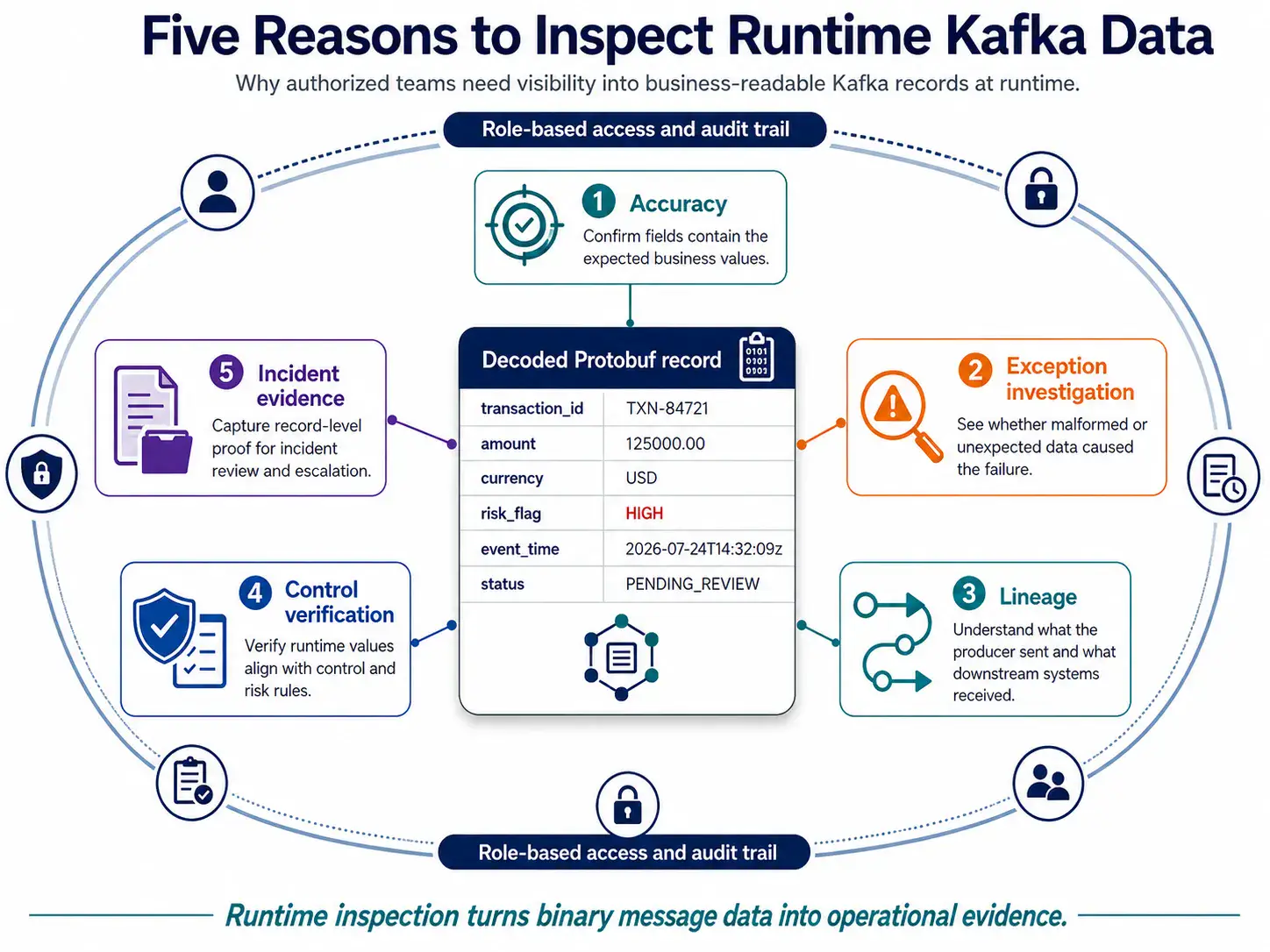
Kafka risk data validation turns decoded runtime records into evidence for accuracy checks, exception investigation, lineage analysis, control verification, and incident review.
1. Verify that technically valid data is also business-correct
A record can conform to a schema and still be wrong. A field may contain an allowed numeric type but the wrong amount. A status may be a valid enum but inappropriate for the transaction’s stage. A timestamp may parse correctly but fall outside the business window. A routing code may be structurally valid but direct the event to the wrong process.
Schema validation answers whether the data fits the contract. Runtime inspection helps answer whether the values make sense in the business context. That distinction is central to risk management because many material errors are semantically wrong rather than syntactically invalid.
2. Investigate exceptions while the evidence is still available
Risk teams often work from exceptions: a transaction was held, a limit was exceeded, a downstream control rejected an event, or a reconciliation report did not match. The team may need to determine what value entered the stream, not merely what a later application logged.
Kafka retention and compaction policies affect how long the exact record remains available. Under time- or size-based retention, older segments are removed. Under compaction, older records for a key may be eliminated while the latest state remains.[2] Timely, offset-aware inspection can preserve the factual sequence needed to understand an exception.
3. Confirm data lineage and handoffs
Data lineage is the ability to trace data from origin through transformation and use. In a 2026 implementation update on BCBS 239, the Basel Committee emphasized that accurate, comprehensive, and timely data capabilities remain critical to identifying and managing material risk, and it highlighted lineage as important for confirming data quality.[3]
Kafka is frequently one step in a longer path. A source application produces an event, stream processing enriches or transforms it, and one or more consumers update systems of record or analytical platforms. When values diverge, teams need to compare what existed at different points in the flow.
Decoded record inspection gives operations a concrete checkpoint. The team can document the producer’s output before transformation, compare it with a downstream event, and determine where a value changed. That does not replace an enterprise lineage program, but it provides message-level evidence inside the operational workflow.
Business questions that infrastructure health cannot answer
| Risk or Operations Question | Why Metrics Are Insufficient | What Decoded Inspection Contributes |
|---|---|---|
| Was the amount or quantity correct? | Throughput and latency do not evaluate the business value. | Displays the actual field value in the selected record. |
| Did the producer send the expected status? | A successful produce operation confirms delivery, not semantic correctness. | Shows the status and surrounding fields as produced. |
| Where did a value change? | End-to-end telemetry may locate services but not every transformation result. | Provides a checkpoint for comparing records across topics or stages. |
| Was an exception triggered by data or code? | Errors identify the failure but may not retain sensitive payload details. | Lets an authorized user compare the record with the application rule. |
| Can the team support an urgent review? | Aggregate dashboards may not provide event-level evidence. | Supplies a readable record tied to a topic, partition, offset, and time. |
4. Validate control outcomes and producer behavior
A control may depend on fields such as approval state, source system, classification, jurisdiction, threshold, or risk score. If a control behaves unexpectedly, the investigation should separate three possibilities: the producer sent an incorrect value, an intermediate service changed the value, or the control interpreted a correct value incorrectly.
Direct record inspection gives the team a way to test those hypotheses. An authorized operator can decode the relevant Protobuf record using the customer’s .proto definition, review the fields, and provide evidence to the application owner. If appropriate, a controlled test record can be created in a nonproduction environment to verify the expected behavior.
5. Reduce dependence on emergency development work
Without an administrative inspection tool, teams may ask a developer to write a temporary consumer, add diagnostic logging, or replay data through a special application. Those approaches can work, but they introduce delays and may require code changes, credentials, deployment approvals, and cleanup after the incident.
A governed portal can move routine inspection into the operations process. Developers still define and own the application contract. Operations gains a controlled way to read selected records without becoming the application-development team.
Governance is part of the feature, not an afterthought
Business-readable payloads can contain sensitive information. The solution should not give every Kafka user unrestricted access to every topic. NIST’s least-privilege guidance calls for limiting authorized access to what users need for assigned tasks and reviewing privileges regularly.[4] The same principle should apply to message-content inspection.
Organizations should define which roles can inspect payloads, which environments and topics they can access, whether masking is required, and how actions are audited. Infrared360 is designed to restrict access by groups and roles and to record administrative actions in audit trails.[5] That makes it possible to separate platform ownership from risk review and application support.
The permission model should also distinguish read-only inspection from actions such as producing a test record. Production access may require a higher level of approval than nonproduction testing. Retention of audit evidence should align with the organization’s operational and regulatory requirements.
Runtime inspection is not continuous surveillance of every payload
The case for message inspection is not a recommendation to decode and analyze all records continuously. That would create performance, privacy, and governance concerns. The operational model is selective: monitoring or a business exception identifies a reason to investigate, then an authorized user examines the minimum necessary record set.
This targeted approach also keeps responsibilities clear. Monitoring identifies abnormal behavior. Data-quality and risk controls identify exceptions. Record inspection supplies evidence. Application teams correct defects. Audit trails document who accessed or acted on the environment.
Questions to include in an evaluation
Ask whether the tool can use the organization’s real .proto definitions, including imports and nested structures. Confirm whether keys and values can be inspected, how records are located by partition, offset, and timestamp, and whether the tool supports the framing used by the producers. Review access controls, audit detail, masking options, and separation between production and nonproduction privileges.
Most importantly, begin with a business scenario. Choose a realistic exception and determine whether the team can move from alert or inquiry to an understandable record without uncontrolled payload logging or emergency code development.
The takeaway
Risk and operations teams inspect Kafka business values because platform health is not the same as data correctness. The ability to see a decoded Protobuf record can help verify an event, investigate an exception, support lineage, test a control, and resolve disputes between producing and consuming applications.
When that access is role-based, selective, and audited, message inspection becomes more than a convenience. It becomes part of the organization’s operational evidence model.
FAQ
Endnotes
- Protocol Buffers Documentation, “Overview.” https://protobuf.dev/overview/
- Apache Kafka Documentation, “Design: Log Compaction.” https://kafka.apache.org/42/design/design/
- Basel Committee on Banking Supervision, “Implementation of the Principles for Effective Risk Data Aggregation and Risk Reporting (BCBS 239 Principles),” January 6, 2026. https://www.bis.org/publ/bcbs_nl36.htm
- NIST Special Publication 800-171 Revision 3, “03.01.05 Least Privilege.” https://nvlpubs.nist.gov/nistpubs/SpecialPublications/800-171r3/NIST.SP.800-171r3.html
- Avada Software, “Infrared360 Product Details.” https://avadasoftware.com/infrared360-product-details/
Related Posts




More Infrared360® Resources
About the Author: Scott Treggiari