This is Part 5 of a 6-part series exploring how to use IBM MQ as a reliable ingestion layer for AI and RAG.
For the full article, click here | Previous Article | Next Article
IBM MQ Access Control for AI Pipelines: Managing Visibility Across Teams
As IBM MQ becomes part of AI and RAG pipelines, governance becomes more complex—not less.
In traditional MQ environments, access control is often limited to a small group of administrators and developers. But when MQ feeds AI pipelines, more teams become involved in the flow of data.
That includes:
- middleware teams
- application developers
- integration engineers
- AI and data platform teams
- operations and support teams
Each of these groups needs visibility into the system. But not all of them should have the same level of access.
Why access control becomes harder in MQ-to-AI architectures
In an MQ-to-AI design, the ingestion path is no longer owned by a single team.
Messages may:
- originate from one system
- pass through MQ managed by another team
- be consumed by a separate ingestion service
- be transformed and indexed by a different platform
When something goes wrong, multiple teams need to understand what is happening.
But without proper access control and visibility:
- teams are blocked from seeing the data they need
- troubleshooting slows down
- access is over-granted just to “get things done”
- operational risk increases
The real problem: visibility vs control
Most MQ environments fall into one of two patterns:
Too restrictive
- Only MQ admins can see queues and message data
- Other teams rely on tickets or screenshots
- Troubleshooting takes longer
Context is lost between teams
Too permissive
- Broad access is granted to multiple teams
- Users can view or interact with queues they should not
- Risk of accidental changes increases
- Security and compliance concerns grow
Neither model works well for AI pipelines, where:
- more teams are involved
- issues can span multiple systems
- faster troubleshooting is required
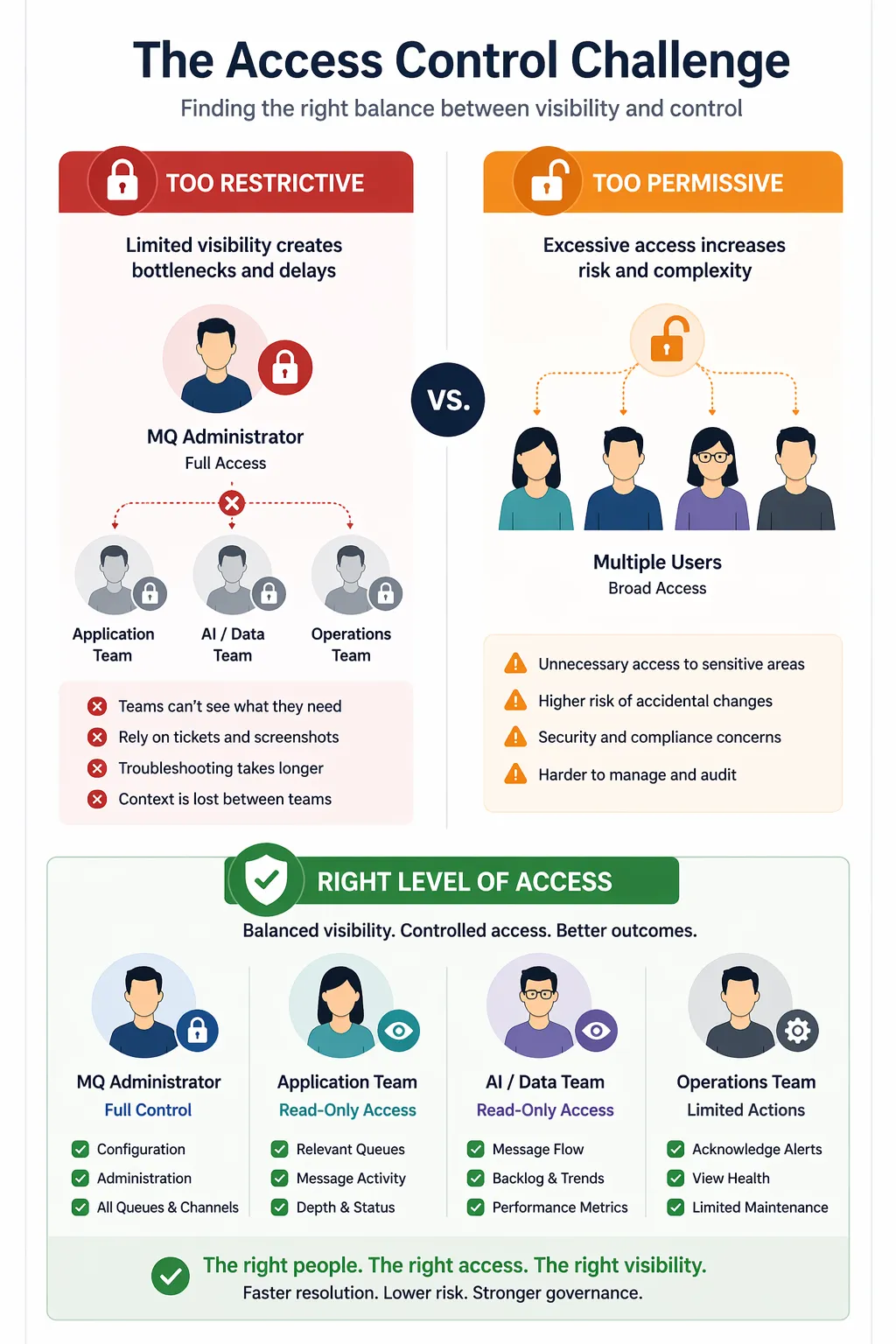
The IBM MQ access control challenge is finding the right balance between shared visibility and controlled access.
What effective MQ access control looks like
A more effective approach balances visibility and control.
That means:
Role-based visibility
Different teams can:
- view queues relevant to them
- see message flow, depth, and activity
- understand system health
Without necessarily being able to:
- modify configurations
- clear queues
- start or stop channels
Controlled operational access
When action is needed:
- permissions are scoped
- actions are limited to specific objects
- sensitive environments are protected
Shared operational context
Teams should be able to:
- see the same data
- understand the same conditions
- collaborate without needing full system access
This is especially important when diagnosing:
- ingestion delays
- backlog issues
- routing problems
- downstream bottlenecks
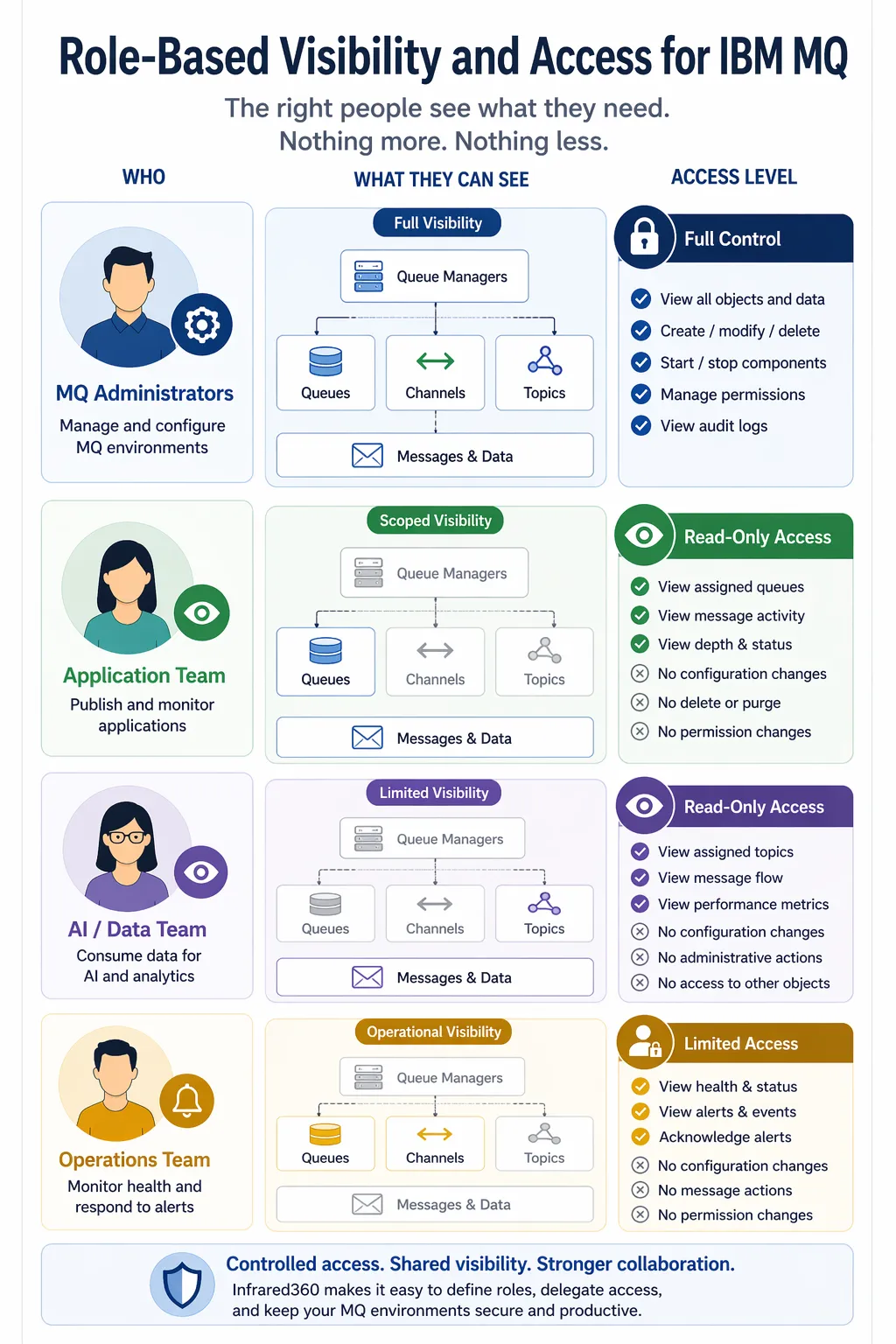
Role-based visibility and access for IBM MQ helps the right people see what they need while limiting unnecessary control.
Why this matters more in AI pipelines
In AI-driven systems, problems are not always obvious.
A delay in message consumption may:
- appear as stale AI responses
- show up as incomplete search results
- surface as data inconsistencies
Without shared visibility:
- MQ teams may see normal activity
- AI teams may see degraded performance
- neither team sees the full picture
This leads to:
- longer resolution times
- misdiagnosed issues
- unnecessary escalations
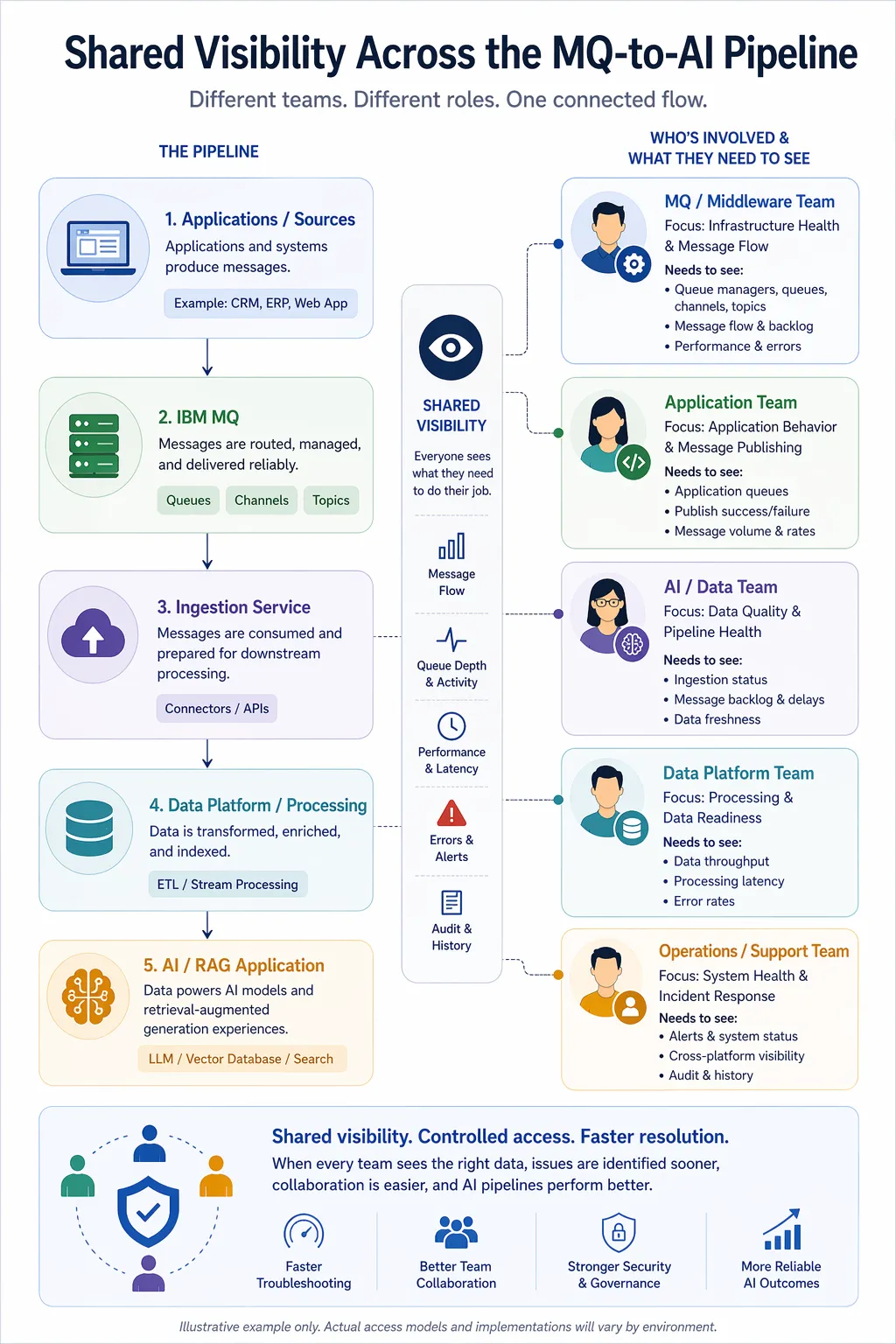
Shared visibility across the MQ-to-AI pipeline helps each team see the data they need without requiring the same level of access.
Where governance capabilities make the difference
In these environments, governance is not just about restricting access. It is about enabling the right level of access for the right people.
Teams benefit from capabilities such as:
- Granular role-based access control (RBAC)
Define exactly what users can see and do across queue managers, queues, and environments. - Delegated visibility without full administrative rights
Allow application or AI teams to view MQ activity without granting full control. - Audit trails and accountability
Track who accessed what and what actions were taken, supporting compliance and operational transparency. - Environment-level separation
Ensure production, test, and development environments are clearly segmented and controlled. - Centralized visibility across MQ environments
Provide a unified view so teams do not need to access multiple systems or tools to understand what is happening.
A practical example
Consider a support-ticket ingestion pipeline:
- MQ team manages queue managers and routing
- Application team produces ticket
- messages
AI team consumes processed data for a knowledge assistant
If ticket ingestion slows down:
- The AI team needs to see message flow and backlog
- The MQ team needs to verify queue health
- The application team may need to confirm message structure
Without shared visibility:
- each team works in isolation
- resolution takes longer
With controlled, role-based visibility:
- each team sees what they need
- no one has excessive access
- issues are resolved faster
Key takeaways
- IBM MQ access control becomes more complex as more teams interact with AI ingestion pipelines
- The challenge is balancing visibility with control—not choosing one over the other
- Too little access slows troubleshooting; too much access increases risk
- Role-based visibility, controlled access, and shared context are essential for efficient operations
- Governance capabilities directly impact how quickly teams can identify and resolve issues
This is Part 5 of a 6-part series exploring how to use IBM MQ as a reliable ingestion layer for AI and RAG.
For the full article, click here | Previous Article | Next Article
Related Posts




More Infrared360® Resources
About the Author: Scott Treggiari