This is Part 4 of a 6-part series exploring how to use IBM MQ as a reliable ingestion layer for AI and RAG.
For the full article, click here | Previous Article | Next Article
Test IBM MQ Messages for AI: How to Validate the Ingestion Path
When IBM MQ feeds an AI or RAG pipeline, testing needs to prove more than basic message movement.
It is not enough to know that a message can be placed on a queue. Teams also need to understand whether the MQ side of the ingestion path can handle realistic payloads, preserve the right message characteristics, route messages to the intended targets, and support expected volume or burst patterns.
That is why teams need a practical strategy to test IBM MQ messages for AI before these flows become part of production operations.
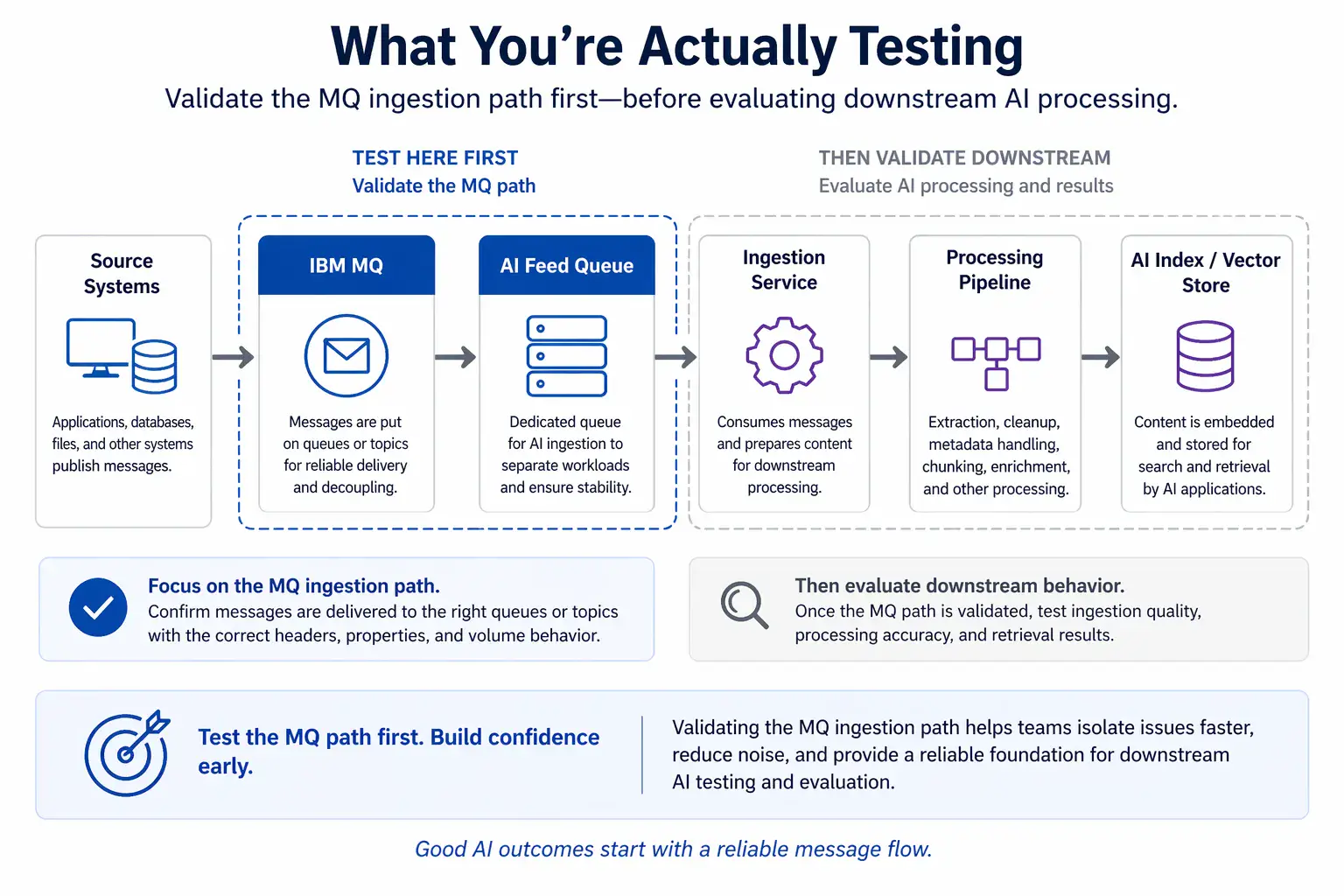
Testing should validate the MQ ingestion path before downstream AI processing is evaluated.
Why MQ testing matters in AI ingestion pipelines
In many enterprise AI designs, IBM MQ acts as the reliable ingestion and decoupling layer. Source systems publish messages to MQ, and downstream services consume those messages to prepare content for AI use.
That downstream path may include:
- ingestion services
- text extraction
- data cleanup
- metadata handling
- embedding generation
- vector indexing
But before teams evaluate downstream AI quality, they need to validate the MQ side of the design.
That means asking questions such as:
- Are messages reaching the intended queues or topics?
- Are headers and properties represented correctly?
- Are message counts and rates realistic?
- Can the MQ side handle burst-volume conditions?
- Can tests be repeated after configuration or application changes?
If those fundamentals are not tested, downstream teams may spend time diagnosing problems that began earlier in the message flow.
Start with the MQ path
The first goal is to prove that test messages follow the expected MQ path.
For an AI ingestion design, that may include:
- a source queue
- a streamed or duplicated AI feed queue
- one or more target queues or topics
- defined static targets for generated test messages
This is especially important when teams use separate queues for AI ingestion so the AI pipeline does not compete with the primary production consumer.
Testing should confirm that generated messages are received at the intended MQ target. That helps validate that the MQ-side route is behaving as expected before teams begin troubleshooting downstream processing or AI behavior.
Test realistic payloads, not “hello world” messages
A single simple test message is useful for proving that a queue is reachable. It is not enough to prove that the ingestion path is ready.
AI ingestion pipelines often depend on the structure and content of the message. The downstream service may expect specific payload formats, fields, headers, or properties.
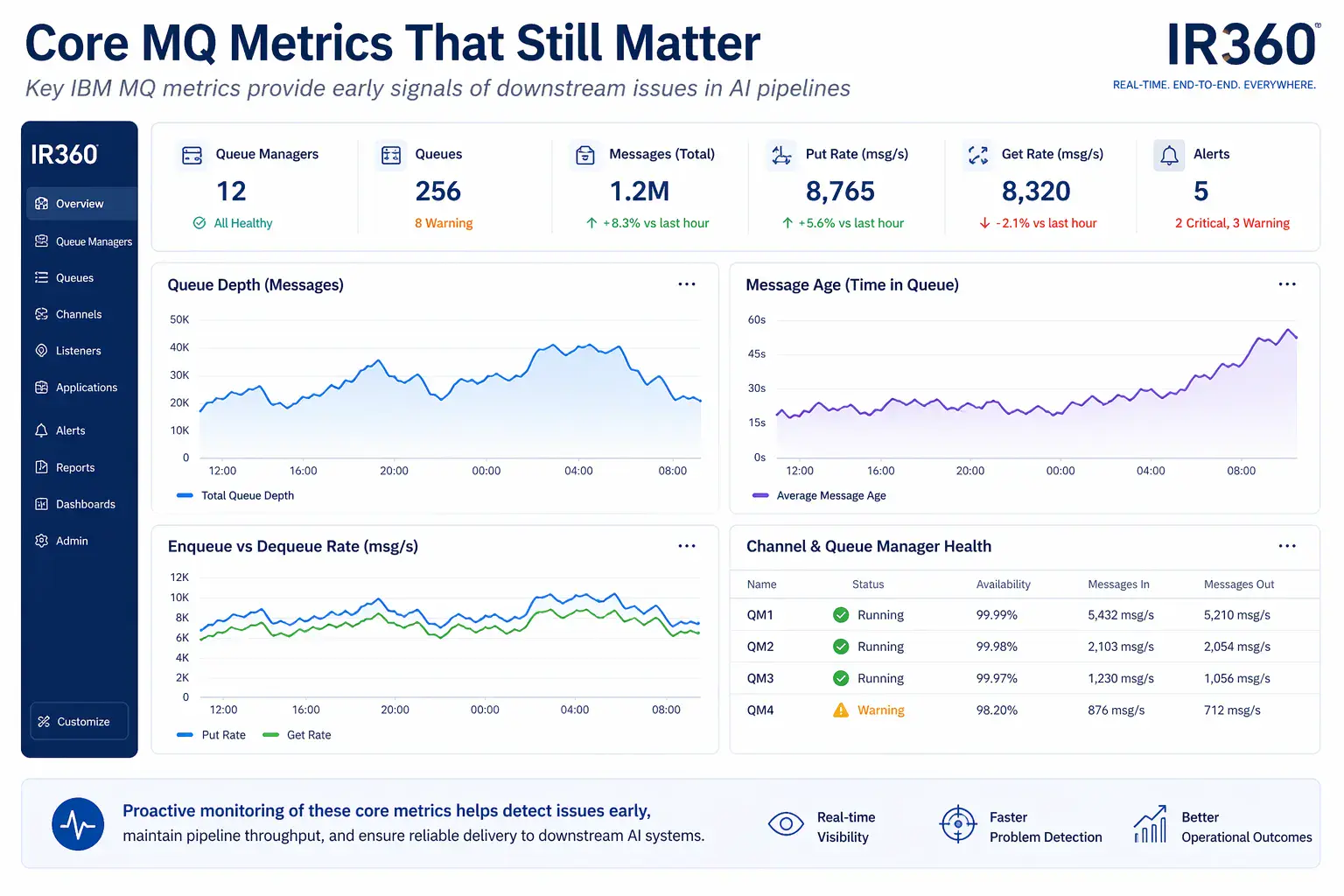
Core MQ metrics provide early signals of downstream issues in AI pipelines.
That is why realistic MQ message testing should account for:
- message size
- message format
- content structure
- optional or missing fields
- special characters or encoding
- duplicate or replayed messages
- malformed but realistic edge cases
For example, if support-ticket data is being fed to a knowledge assistant, test messages should look like support-ticket messages. They should include representative subject lines, issue descriptions, severity values, product identifiers, timestamps, and any other fields that influence downstream handling.
Include headers and message properties
The message body is only part of what needs to be tested.
In MQ-based AI ingestion, headers and message properties can matter because they may help downstream services identify, classify, route, or enrich content. A test that ignores headers and properties may miss problems that appear only with more realistic messages.
Testing should consider:
- MQI or JMS message type
- header data sets
- JMS properties where applicable
- message identifiers
- correlation values
- business properties used for routing or filtering
This is especially important when metadata will later be mapped into downstream index or retrieval metadata.
Test message counts, rates, and bursts
AI ingestion pipelines can behave differently under load.
A design that works with five messages may behave very differently when hundreds or thousands arrive in a short period. MQ may continue accepting messages, but the downstream ingestion path may slow down, causing backlog, rising message age, or delayed processing.
That is why teams should test:
- controlled message counts
- repeated execution
- scheduled test runs
- burst-volume scenarios
- sustained traffic patterns
- post-change regression runs
The goal is not simply to generate a large number of messages. The goal is to understand how the MQ-side path behaves under expected and unexpected conditions.
Test after change, not only before go-live
MQ-to-AI ingestion paths can change over time.
Teams may update:
- queues or topics
- routing rules
- message formats
- header requirements
- security settings
- ingestion consumers
- downstream dependencies
Each change can affect whether messages continue to move as expected.
That is why testing should be repeatable. Teams should be able to rerun known test cases after changes to confirm that the MQ side of the ingestion path still behaves correctly.
Repeatable testing is especially useful for:
- regression testing
- release validation
- readiness checks
- scheduled canary-style tests
- troubleshooting suspected routing issues
A simpler way to test IBM MQ messages for AI
Testing the MQ side of an AI ingestion design does not have to depend on one-off manual messages or custom scripts for every scenario.
Infrared360’s Message Test Cases are designed to generate simple or complex messages to queues or topics, using MQI, JMS, or both. Test cases can include configurable message counts, header data sets, JMS properties, content resources, static targets, queue-clearing options, audit history, notifications, and scheduled execution.
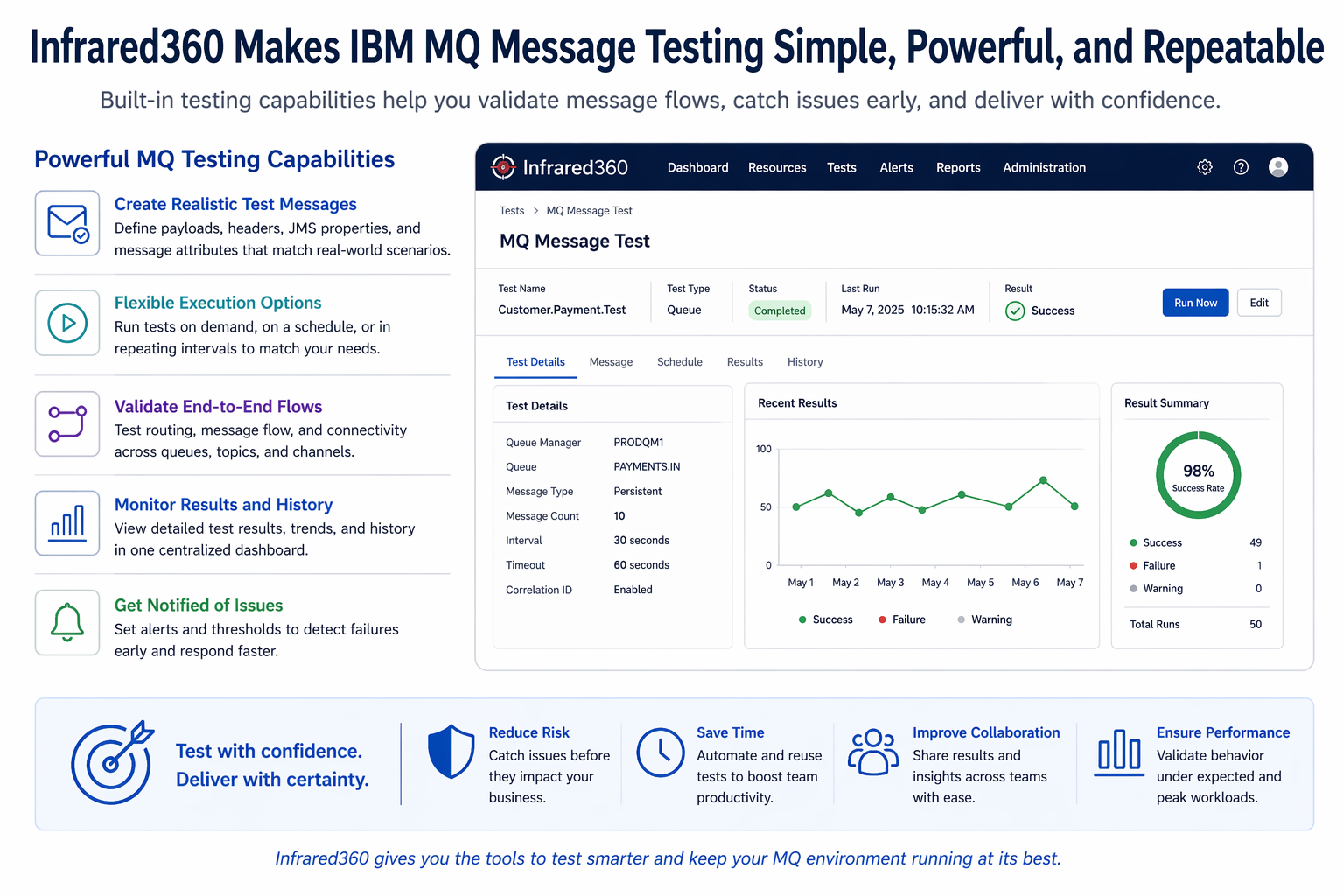
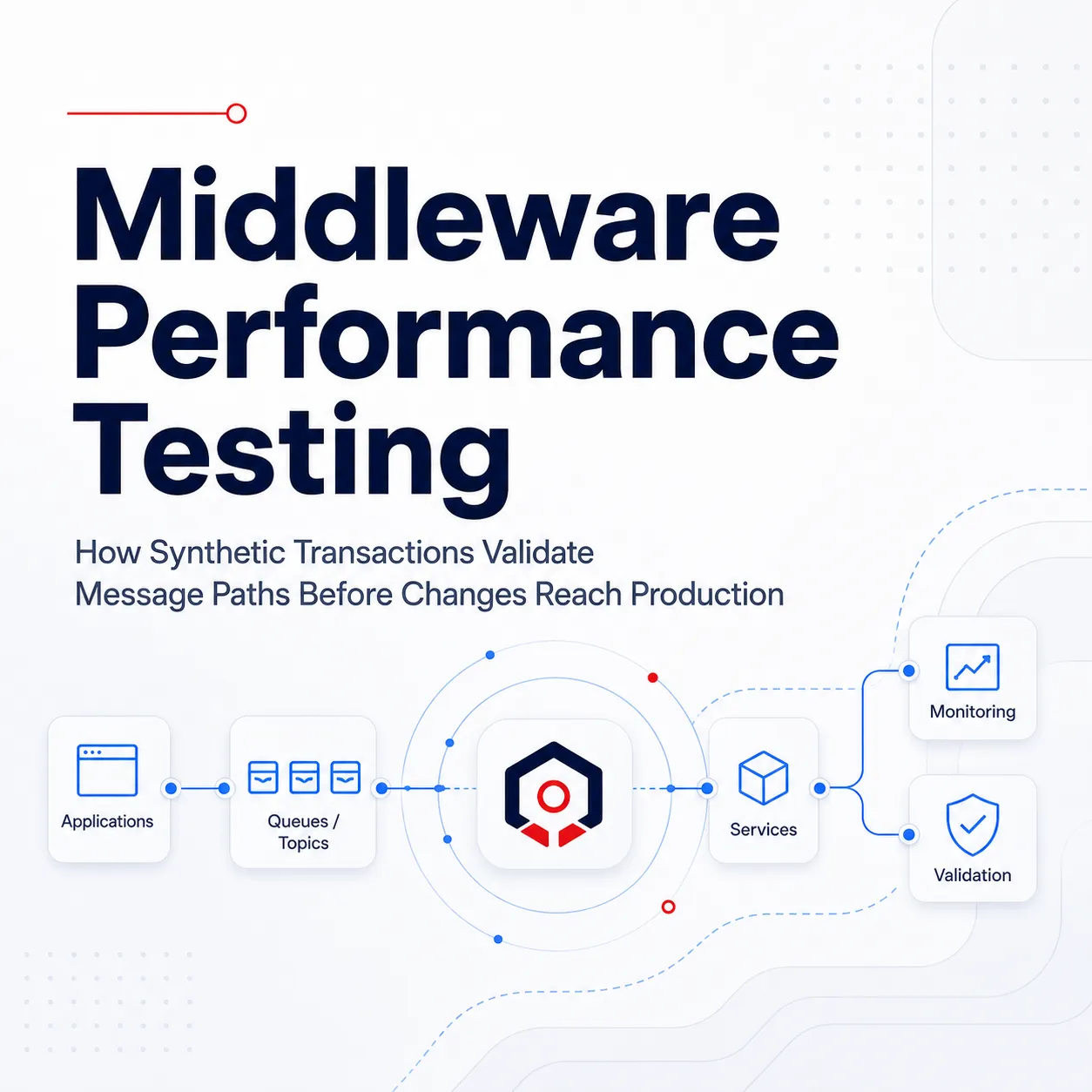
Synthetic message testing enables repeatable, controlled validation of MQ ingestion paths.
That makes Infrared360 useful for testing the MQ side of an AI ingestion design in a repeatable and controlled way.
Teams can use synthetic message testing to:
- generate realistic test messages
- include headers and JMS properties
- send messages to intended queues or topics
- configure large or unlimited test-message volumes
- test repeat execution and scheduled runs
- model burst-volume scenarios
- support regression testing after change
- maintain audit history of test execution
- trigger notifications when tests run
This is especially useful for AI ingestion because the issue is often not whether one message can be sent. It is whether the MQ-side path behaves as expected when realistic messages arrive in meaningful volume, with the right headers, properties, payload structure, and routing.
This does not replace downstream AI-quality testing. Teams still need to evaluate retrieval quality, chunking strategy, vector search settings, and answer quality separately. But validating the MQ path first gives those downstream teams a more reliable foundation.
What to look for after running tests
After test messages are generated, teams should evaluate MQ-side behavior.
Useful checks include:
- Did the expected number of messages arrive?
- Did messages arrive at the intended target?
- Did queue depth behave as expected?
- Did message age increase unexpectedly?
- Did consumers pick up messages at the expected rate?
- Were backout or retry patterns observed?
- Did any queues need to be cleared before or after the test?
- Did scheduled tests execute when expected?
These checks help teams determine whether the MQ path is ready, where bottlenecks may appear, and whether additional tuning or investigation is needed.
Key takeaways
- To test IBM MQ messages for AI, teams should validate more than simple connectivity.
- Realistic payloads, headers, properties, routing, message counts, and burst-volume behavior all matter.
- MQ-side testing should be repeatable so teams can rerun known scenarios after changes.
- Synthetic transaction testing helps validate the MQ ingestion path before downstream AI-quality testing begins.
- Testing the MQ path does not replace testing the AI assistant, retrieval logic, or vector index. It gives those downstream teams a more reliable foundation.
This is Part 4 of a 6-part series exploring how to use IBM MQ as a reliable ingestion layer for AI and RAG.
For the full article, click here | Previous Article | Next Article
Related Posts


More Infrared360® Resources
About the Author: Scott Treggiari