This is Part 2 of a 6-part series exploring how to use IBM MQ as a reliable ingestion layer for AI and RAG.
For the full article, click here | Previous Article | Next Article
Designing an IBM MQ RAG Architecture That Actually Works
Using IBM MQ in AI pipelines is not about connecting MQ to a model. It is about designing a clean ingestion architecture.
A typical MQ-to-RAG pipeline looks like this:
Source systems → IBM MQ → ingestion service → transformation → embeddings → vector index → application
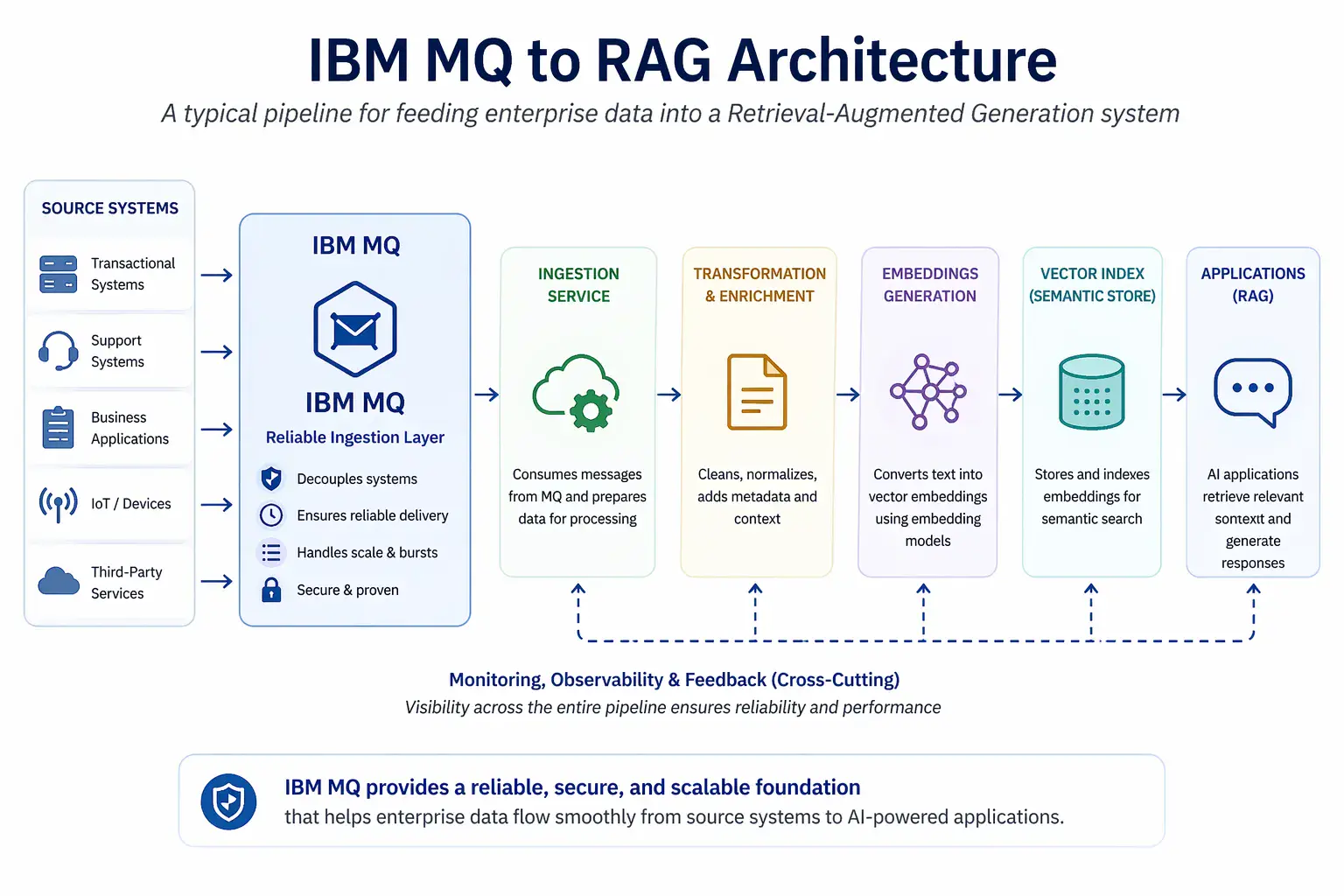
Use a dedicated ingestion path
Do not let AI consumers compete with production consumers.
Instead, create a separate feed using:
- streaming queues
- duplication patterns
- or dedicated routing
This ensures the AI pipeline does not interfere with core operations.
Treat metadata as first-class
MQ messages include more than payload.
Fields like:
- message ID
- correlation ID
- timestamps
- business identifiers
should be explicitly mapped into downstream metadata.
This is critical for:
- filtering results
- tracing data
- improving retrieval relevance
Design for completeness
If your AI system depends on complete data, do not assume duplication is “good enough.”
You need to:
- validate delivery
- monitor ingestion
- test duplication behavior
Avoid overcomplication
The goal is not to embed AI logic into MQ.
The goal is to use MQ as a clean ingestion boundary.
Architecture is only part of the solution
Designing an IBM MQ to RAG architecture is only part of the challenge. The way that architecture behaves in production matters just as much.
In these designs, MQ is no longer feeding a single downstream system. It is feeding a pipeline that may include multiple services, APIs, and storage layers. Each of those introduces potential points of delay or failure.
That means architects need to think not only about how messages flow, but how that flow will be observed, monitored, and validated over time.
Without that visibility, issues such as message backlogs, slow ingestion, or downstream processing failures can develop without being immediately obvious at the MQ layer.
A strong architecture, combined with strong operational visibility, is what makes these systems reliable in practice.
Where architecture decisions show up later
The choices you make in an IBM MQ to RAG architecture do not stay isolated in design diagrams. They show up later in how the system behaves under load, how easily issues can be identified, and how quickly teams can respond when something goes wrong.
Queue structure, duplication strategy, metadata handling, and ingestion flow all directly influence how observable and manageable the pipeline will be in production.
That is why architecture and operational visibility cannot be treated as separate concerns.
If you are designing an IBM MQ to RAG architecture, the next step is understanding how those choices impact monitoring, visibility, and operational control in real environments.
This is Part 2 of a 6-part series exploring how to use IBM MQ as a reliable ingestion layer for AI and RAG.
For the full article, click here | Previous Article | Next Article
Related Posts




More Infrared360® Resources
About the Author: Scott Treggiari