On this page
IBM MQ® can support some of the most time-sensitive digital interactions in travel and transportation, including bookings, travel updates, fare payments, baggage-related processes, hospitality systems, and loyalty programs.[1][2]
For Middleware Operations Leaders, the challenge increases as IBM MQ expands across more applications, environments, locations, and teams.
The goal is to keep the MQ environment visible, reliable, secure, and manageable while giving the right teams the access and information they need. Infrared360® helps bring IBM MQ monitoring, administration, alerting, testing, automation, reporting, and delegated access together in one centralized platform.
Why IBM MQ Matters in Travel and Transportation
Travel systems depend on information moving between applications quickly and reliably.
IBM identifies travel and transportation uses for IBM MQ across airlines, hotels, loyalty systems, transit, fare payments, passenger information, cargo, ticketing, flight updates, baggage handling, and bookings.[1][2]
When these systems depend on messaging, an MQ issue can quickly become a business issue.
A delayed message might affect a reservation. A stalled consumer could slow a customer-facing process. A channel problem could interrupt communication between systems. A certificate issue could prevent an application from connecting altogether.
That makes MQ operations about more than checking whether a queue manager is running. Teams need to understand whether the message flow itself is healthy.
What Gets Harder as an IBM MQ Environment Grows?
The larger the MQ environment becomes, the harder it is to maintain a clear operational picture.
A Middleware Operations Leader may be responsible for queue managers spread across production, testing, disaster recovery, cloud environments, data centers, regions, and multiple business applications.
At that point, some simple questions become harder to answer:
| Operational Challenge | What the Team Needs |
|---|---|
| Finding the problem | Quickly locate the affected queue manager, queue, channel, or application environment. |
| Understanding message health | See whether messages are moving normally, slowing down, or beginning to accumulate. |
| Coordinating multiple teams | Give application and support teams the visibility they need without giving everyone full administrative access. |
| Responding consistently | Create repeatable processes for common incidents and operational tasks. |
| Managing change | Validate releases, migrations, configuration changes, certificates, and recovery events. |
| Understanding what happened | Maintain useful historical and audit information for troubleshooting and review. |
The challenge shifts from managing individual MQ objects to operating the MQ estate as a service.
How Infrared360 Helps IBM MQ Operations Scale
Infrared360 gives Middleware Operations Leaders a centralized way to monitor and manage IBM MQ across distributed environments.
Rather than requiring teams to work through separate views of individual queue managers, Infrared360 provides a common operational view for monitoring, troubleshooting, administration, access control, testing, and automation.
Centralize MQ Visibility
When an incident begins, one of the first questions is usually: Where is the problem?
Infrared360 helps teams find and work with MQ resources across managed environments from a central interface.
This is especially useful when the same application spans development, testing, production, disaster recovery, or multiple geographic locations.
Instead of treating every queue manager as an isolated system, operations teams can view the environment in a broader application and business context.
Detect Problems Earlier
Availability alone does not tell you whether a messaging service is healthy.
A queue manager may still be running while messages begin to build up or an application stops consuming them at the expected rate.
Infrared360 provides True Real-Time™ monitoring and MQ-specific alerting so teams can watch the conditions that matter to their environment and respond when behavior changes.
For example, imagine a booking application where messages continue arriving while processing begins to slow.
The middleware team may see message buildup, aging messages, or changes in application activity before the issue becomes a complete outage.
That gives the team a better starting point for determining whether the problem involves MQ, the consuming application, a connection, a channel, or another dependency.
Give Different Teams the Right Level of Access
Large travel organizations usually have many teams that depend on middleware.
An application support team may need visibility into its own queues and channels. Operations may need access to monitoring and approved recovery actions. Middleware administrators require broader control.
Infrared360 Trusted Spaces™ lets organizations organize access around responsibilities, applications, environments, business units, or other logical groups.
This helps application and support teams work more independently while the central MQ team maintains control over the broader environment.
For Middleware Operations Leaders, that can mean fewer routine requests coming back to MQ specialists and clearer boundaries around who can see and manage different resources.
Standardize Routine MQ Operations
As environments grow, repeatability becomes increasingly important.
Infrared360 provides centralized IBM MQ administration and automation that can help teams create more consistent processes for routine work, troubleshooting, configuration changes, and recovery.
Instead of relying entirely on individual administrators, one-off procedures, or scattered scripts, organizations can establish approved processes that teams can use when appropriate.
That can help reduce variation between environments and make common operational tasks easier to manage at scale.
Validate Changes and Recovery
A successful infrastructure change does not always mean the complete application path is working.
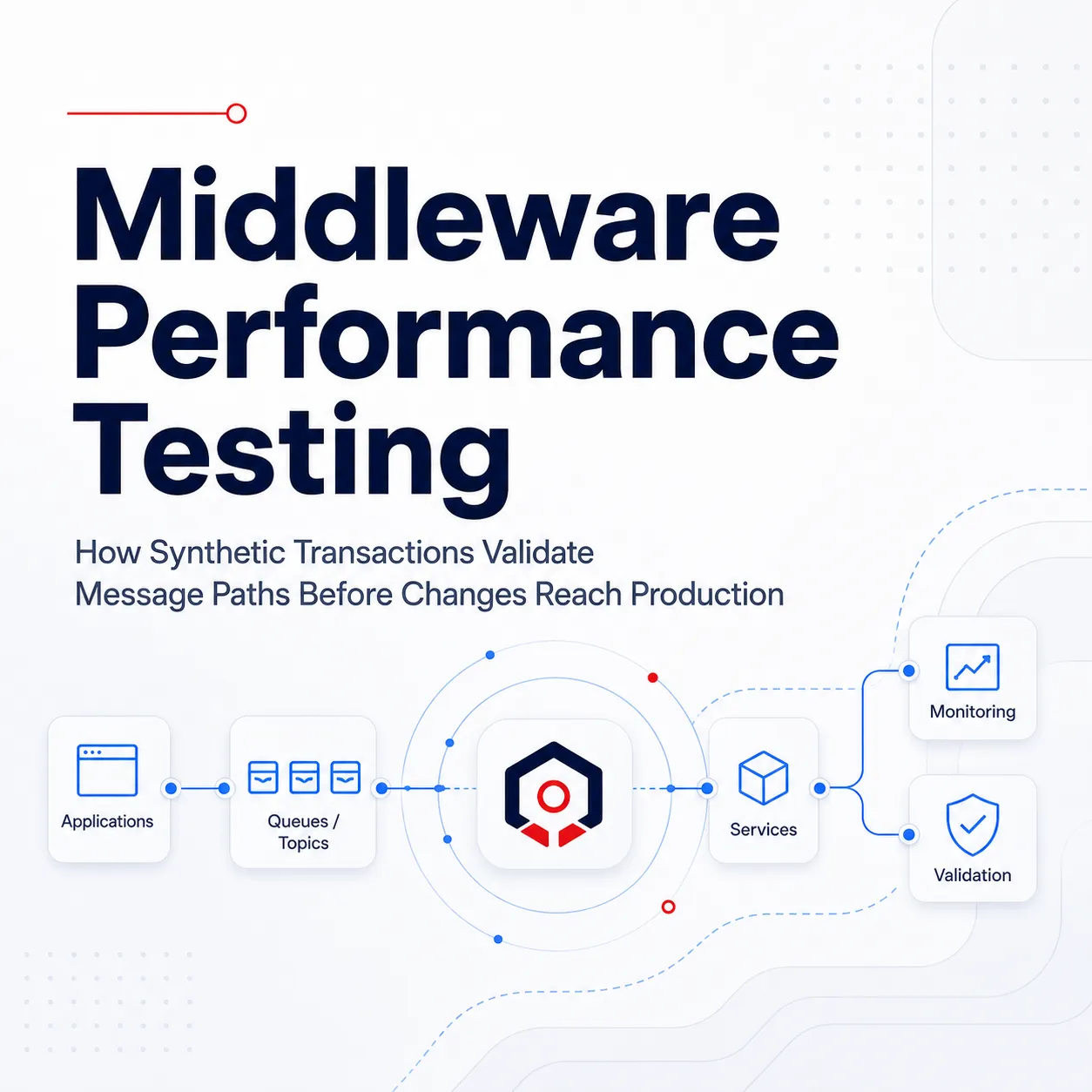
Infrared360 includes synthetic MQ testing that can help teams validate message flows after events such as:
- Application releases
- MQ configuration changes
- Infrastructure migrations
- Certificate changes
- Disaster recovery exercises
The idea is simple: test whether a known message path still works as expected.
This gives the middleware team another way to verify service health after a change instead of relying only on component availability.
Improve Operational History and Visibility
When something changes, teams often need to understand what happened before and after the event.
Infrared360 provides reporting and auditing capabilities that help middleware teams review MQ activity and changes over time.
That historical context can support troubleshooting, incident reviews, change validation, capacity discussions, and operational planning.
Certificate management can also be handled within the broader MQ management environment, helping teams maintain visibility into certificate status and lifecycle activity across distributed queue managers.
Why Agentless MQ Management Matters in Distributed Environments
Infrared360 is agentless, so organizations do not need to deploy an Infrared360 agent alongside every managed IBM MQ queue manager.
For a travel or transportation organization operating across different data centers, cloud environments, regions, or infrastructure platforms, that can reduce another layer of software deployment and maintenance.
The result is a more centralized management model while IBM MQ remains the underlying messaging platform.
Sabre: Managing IBM MQ at Enterprise Scale
Sabre offers a useful example of what IBM MQ operations can look like at travel-industry scale.
Sabre manages more than 800 IBM MQ queue managers and over 2 trillion messages per month, supporting systems that include airline bookings, hospitality applications, and real-time transactions.
At that scale, managing queue managers individually becomes increasingly difficult.
Infrared360 helped bring those MQ operations into a centralized environment while supporting real-time monitoring and delegated access through Trusted Spaces™.
Their experience shows why the operating model becomes just as important as the messaging platform itself when MQ reaches enterprise scale.
When Does Centralized IBM MQ Management Make Sense?
A centralized MQ operations platform becomes especially valuable when an organization has:
- Many queue managers across different applications, environments, locations, or infrastructure platforms
- Multiple teams that need different levels of MQ visibility and access
- Time-sensitive message flows where problems need to be identified quickly
- Frequent releases, migrations, certificate changes, or disaster recovery testing
- Repetitive MQ administration or troubleshooting processes
- A need for stronger historical visibility and operational consistency
The important question for a Middleware Operations Leader is:
Can your current MQ operating model continue to scale as the number of applications, queue managers, teams, and business dependencies grows?
Infrared360 is designed to help organizations answer that challenge with centralized visibility, monitoring, administration, access control, automation, testing, and reporting.
Frequently Asked Questions
How is IBM MQ used in travel and transportation?
IBM MQ can support messaging between systems used for bookings, flight information, baggage handling, fare payments, passenger information, hotel systems, loyalty programs, cargo, ticketing, and other travel transactions.[1][2]
What should travel organizations monitor in IBM MQ?
Teams should monitor the MQ conditions that indicate whether important message flows are operating normally. This can include queue activity, message buildup and age, application activity, channel health, queue-manager availability, and certificate status. The right thresholds depend on the application and its expected behavior.
How does Infrared360 help manage IBM MQ at scale?
Infrared360 centralizes IBM MQ monitoring, administration, alerting, delegated access, automation, testing, reporting, and auditing. This gives middleware teams a common place to operate MQ environments that may span many queue managers, applications, and teams.
How can application teams access IBM MQ without receiving full administrative access?
Infrared360 Trusted Spaces™ lets organizations limit visibility and capabilities based on responsibilities, applications, environments, or other logical groupings. This allows teams to work with the MQ resources relevant to them while broader administrative control remains restricted.
Does Infrared360 replace IBM MQ?
No. IBM MQ remains the messaging platform. Infrared360 provides a centralized management and monitoring layer that helps organizations operate IBM MQ across larger and more distributed environments.
Endnotes
[1] IBM — IBM MQ: Travel and Transportation Use Cases. IBM describes real-time travel transactions, fare payments, and messaging across transit, airlines, hotels, and loyalty systems.
[2] IBM — IBM MQ SaaS on AWS: Messaging Built for Hybrid and Multi-Cloud Connectivity. IBM discusses travel examples including flight updates, baggage handling, and bookings.
[3] IBM — IBM MQ 10.0.x Documentation. IBM’s current documentation for secure and reliable messaging across on-premises, cloud, and hybrid environments.