On this page
- What an MQ Engineer Should Expect from an MQ Monitoring and Administration Platform
- Centralized MQ Monitoring and Administration
- How Infrared360 Shortens the Path from Alert to Resolution
- Repeatable Testing, Approved Automation, and Audit
- Financial-Services Operational Considerations
- How Infrared360 Fits with the Tools You Already Use
- Is Infrared360 a Good Fit for Your MQ Environment?
- Conclusion
A practical evaluation guide for MQ engineers comparing monitoring and administration platforms
If you are evaluating an IBM MQ monitoring and administration solution, you probably do not need another tool that only displays queue depth. You need a faster and safer way to see what is happening across the MQ estate, investigate incidents, take approved action, share the right level of visibility with other teams, and retain evidence of what changed.
Infrared360 brings MQ-specific monitoring, administration, alerting, automation, synthetic message testing, reporting, and delegated access into one governed web interface. It helps an MQ engineer move from an alert to the affected object, review the relevant MQ conditions, perform an authorized action, verify recovery, and preserve the activity record without rebuilding the context across several tools.
The product does not replace IBM MQ, native MQ security, ServiceNow, full-stack observability, or the judgment of an experienced engineer. Its role is to make MQ operations more centralized, repeatable, and scalable across a large or regulated organization.
- Centralized monitoring and administration across queue managers and environments.
- MQ-specific visibility into depth, age, rates, readers, writers, handles, channels, connections, backouts, and certificates.
- A shorter path from alert to diagnosis, governed action, verification, and audit.
- Object-level delegated access through Trusted Spaces™.
- Reusable synthetic tests and approved alert-triggered automation.
What an MQ Engineer Should Expect from an MQ Monitoring and Administration Platform
Infrared360 is most relevant when the challenge is not one queue manager, but operating MQ consistently across many systems, teams, applications, and environments. The table below maps common MQ engineering needs to the product capabilities that address them.
| MQ Engineering Need | Typical Problem | Infrared360 Contribution |
|---|---|---|
| Monitor production MQ | Data is scattered across queue managers, consoles, scripts, and monitoring tools. | Centralized MQ-specific monitoring and historical views. |
| Diagnose and resolve incidents | Alerts, investigation, administration, and verification happen in separate tools. | Alert-to-object drill-down with governed administration and recovery checks. |
| Control access | Application teams either wait for MQ staff or receive too much authority. | Trusted Spaces™ limits visibility and actions by object, role, team, or environment. |
| Validate changes | Testing relies on one-off messages and manual post-change checks. | Reusable MQI/JMS test cases with payloads, headers, targets, schedules, and history. |
| Support audit | Evidence is spread across tickets, shell history, screenshots, and logs. | Centralized user, change, service, test, and alert records. |
| Automate repeatable responses | Scripts are disconnected from the alert and approval context. | Rules can trigger approved services, diagnostics, notifications, and corrective actions. |
Centralized MQ Monitoring and Administration
Infrared360 gives engineers a browser-based way to search and work across the managed MQ estate. Instead of starting every investigation by locating a host and opening MQ Explorer or an MQSC session, an engineer can search by object name or pattern and drill into the relevant queue manager, queue, channel, listener, process, connection, topic, or subscription.
MQ conditions you can monitor
The value is MQ-specific visibility, not only host or process availability. Examples include:
- Queue depth, message age, enqueue and dequeue activity, and last put/get activity
- Readers, writers, open handles, connections, and uncommitted messages
- Channel status and instances, queue-manager availability, and transmission queue buildup
- Backout counts, selected message conditions, and certificate expiration
Governed administrative actions
Depending on the user, object, and environment, Infrared360 can provide approved actions such as:
- Start or stop channels and listeners; inspect handles and connections
- Create, change, compare, clone, or back up MQ objects; download or run MQSC
- Refresh security and perform selected queue-manager services
- Put, get, transfer, or replay messages under controlled procedures
How Infrared360 Shortens the Path from Alert to Resolution
In a fragmented workflow, an alert arrives in one product, MQ investigation happens in another, application health is checked elsewhere, recovery requires a separate login, and the incident record is updated manually. Infrared360 keeps more of that MQ workflow together:
- Receive an MQ-specific alert.
- Open the affected queue, channel, connection, or queue manager.
- Review current status, trends, handles, rates, alerts, and related dependencies.
- Perform an authorized diagnostic or administrative action.
- Confirm that message flow is recovering and retain the activity history.
Example: a payment queue is slowing down
Messages continue arriving, dequeue activity falls, message age rises, and the queue manager remains available. A simple process-up check may report a healthy system even though the business flow is degrading.
Infrared360 can combine those signals in one alert, route it to the MQ and application teams, and open the affected queue for investigation. The engineer can check readers, writers, handles, channel state, queue-manager status, and selected downstream services. If the cause is an application dependency, the incident can be updated with evidence instead of treating MQ as the assumed failure point. After recovery, the engineer can confirm that dequeue activity has resumed, message age is declining, and the queue is draining.
Secure MQ Self-Service with Trusted Spaces™
Many MQ teams face an all-or-nothing access problem. If only MQ administrators can see production resources, routine questions become tickets. If broad access is granted to speed up support, users may see or change unrelated objects.
Trusted Spaces separates what a user can see from what that user can do. Visibility and permissions can be limited by queue manager, queue, channel, application, environment, geography, department, business service, or another customer-defined collection.
| Role | Example Visibility and Actions |
|---|---|
| MQ Engineer | Assigned MQ estate with full administration approved for the role. |
| Application Support | Application-specific queues, channels, alerts, and limited recovery actions. |
| Developer or QA | Development and test objects, synthetic tests, and selected nonproduction changes. |
| Production Support | Selected production resources with read-only or narrowly approved actions. |
| Audit or Operations | Reports or service-health views without MQ administration. |
Repeatable Testing, Approved Automation, and Audit
Repeatable synthetic MQ testing
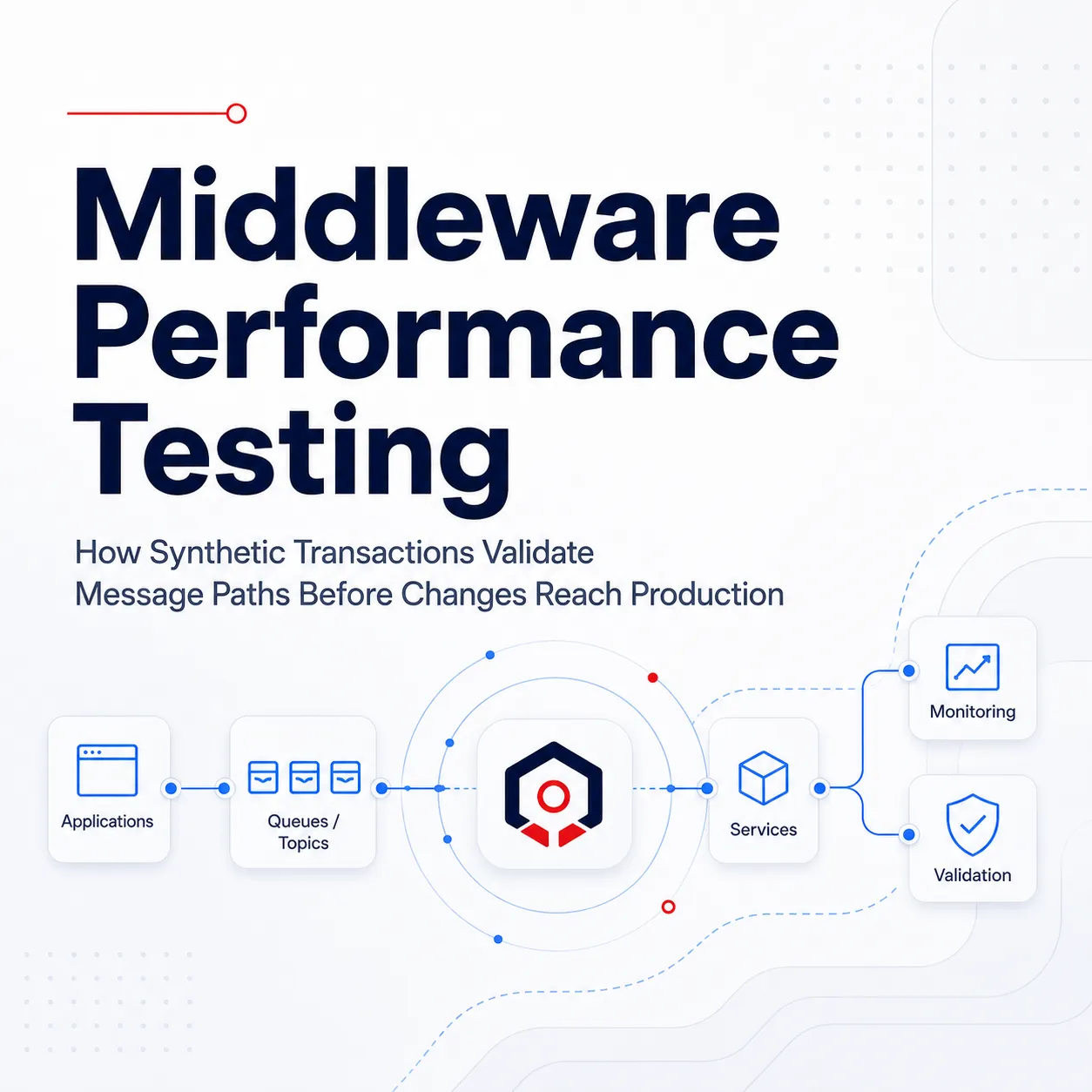
A basic “hello world” message may prove that a queue is reachable, but it does not validate real payloads, headers, properties, routing, production-size messages, burst behavior, downstream processing, or recovery after a change. Infrared360 Message Test Cases can generate MQI or JMS messages with configurable counts, header datasets, JMS properties, payload resources, multiple destinations, repeat intervals, cron schedules, notifications, and execution history.
That makes the capability useful for application onboarding, queue or channel changes, MQ upgrades, certificate rotations, migrations, routing changes, controlled canaries, disaster-recovery exercises, and regression testing.
Approved operational automation
Alerts can trigger predefined services such as MQSC, system commands, REST or URL calls, SOAP, Java, SQL, email, SNMP, logging, and reports. A controlled workflow might create a ServiceNow incident, collect diagnostics, notify the correct team, restart a known transient channel under an approved rule, run a health check, execute a synthetic verification test, and escalate if recovery fails.
Operational evidence
Infrared360 can retain records of user activity, administrative changes, updates and deletions, service execution, test execution, alert activity, and automated actions performed through the platform. Those records can support incident reviews, change validation, access reviews, audit, and operational-risk analysis. They complement rather than replace the institution’s official ITSM, privileged-access, SIEM, and native MQ records
Financial-Services Operational Considerations
| Use Case | How Infrared360 Helps |
|---|---|
| TLS certificate rotation | Expiration visibility, channel monitoring, post-change testing, and evidence. |
| Disaster recovery | Production/DR comparison, monitoring during the switch, synthetic validation, and reporting. |
| Configuration consistency | Search, object comparison, MQSC downloads, backups, and change history. |
| Cross-team support | Application-oriented dashboards and object-level delegated access. |
| Repeated transient issue | Alert-triggered diagnostics, approved remediation, verification, and escalation. |
| Broader service path | Correlates MQ symptoms with selected ACE, application-server, URL, SOAP, database, Kafka, file-system, or downstream conditions. |
Agentless deployment
Infrared360 is agentless and clientless, so a proprietary Infrared360 component does not have to be installed on each MQ endpoint. That can reduce endpoint installation, upgrade coordination, compatibility concerns, and friction with locked-down systems or appliances.
Agentless does not mean configuration-free. The platform still requires secure connectivity, credentials, native MQ permissions, firewall rules, authentication and authorization, TLS configuration, central maintenance, alert design, reporting, retention, and capacity planning.
How Infrared360 Fits with the Tools You Already Use
| Platform or Role | Primary Responsibility |
|---|---|
| IBM MQ | Reliable and secure message transport. |
| MQ Engineer | Architecture, standards, judgment, platform stewardship, and accountability. |
| Infrared360 | MQ-specific monitoring, administration, testing, automation, delegated access, reporting, and audit. |
| ServiceNow or Another ITSM Platform | Enterprise incident, problem, change, approval, and workflow records. |
| Enterprise Observability | Broad application, infrastructure, log, metric, trace, and dependency telemetry. |
| Ansible or CI/CD | Repeatable provisioning, deployment, and configuration promotion. |
Infrared360 does not replace MQ Explorer, native MQ security, correct application transaction design, business reconciliation, formal change approval, HA/DR architecture, full-stack observability, or human judgment for high-risk message operations. It is most valuable as the governed MQ operational layer that connects visibility, action, delegation, testing, automation, and audit.
Is Infrared360 a Good Fit for Your MQ Environment?
Infrared360 is likely to provide the greatest value when several of these conditions apply:
- You operate many queue managers across production, nonproduction, DR, regions, or platforms.
- Multiple MQ, application, integration, support, or audit teams need different levels of access.
- The environment supports business-critical transaction flows and has strict audit requirements.
- Engineers switch among too many monitoring, administration, scripting, and ticketing tools.
- Routine visibility requests consume specialist time.
- Releases, migrations, certificate rotations, and DR exercises require repeatable validation.
- You want approved automation without giving unrestricted authority to every user.
Conclusion
For an MQ engineer evaluating monitoring and administration platforms, Infrared360’s strongest value is the connection between MQ-specific visibility and governed action. It centralizes the estate, surfaces developing message-flow problems, reduces tool switching, delegates selected access safely, supports realistic testing, automates approved responses, and retains MQ-specific operational evidence.
It does not make MQ expertise less important. It helps apply that expertise more consistently across applications, teams, environments, and business units.