IBM MQ Testing Worksheet
Plan Repeatable IBM MQ Synthetic Transaction Tests Before Go-Live
Use this reusable checklist to plan IBM MQ message test cases for MQ-side readiness, including message generation, realistic payloads, headers, JMS properties, targets, scheduling, audit history, notifications, and burst-volume scenarios.
- Define target queues, topics, message types, payloads, headers, and JMS properties
- Plan baseline, regression, scheduled canary, and burst-volume test scenarios
- Document MQ-side expected results, audit needs, notifications, and post-run findings
Get immediate access to the reusable worksheet.
A One-Off MQ Test Does Not Prove Production Readiness
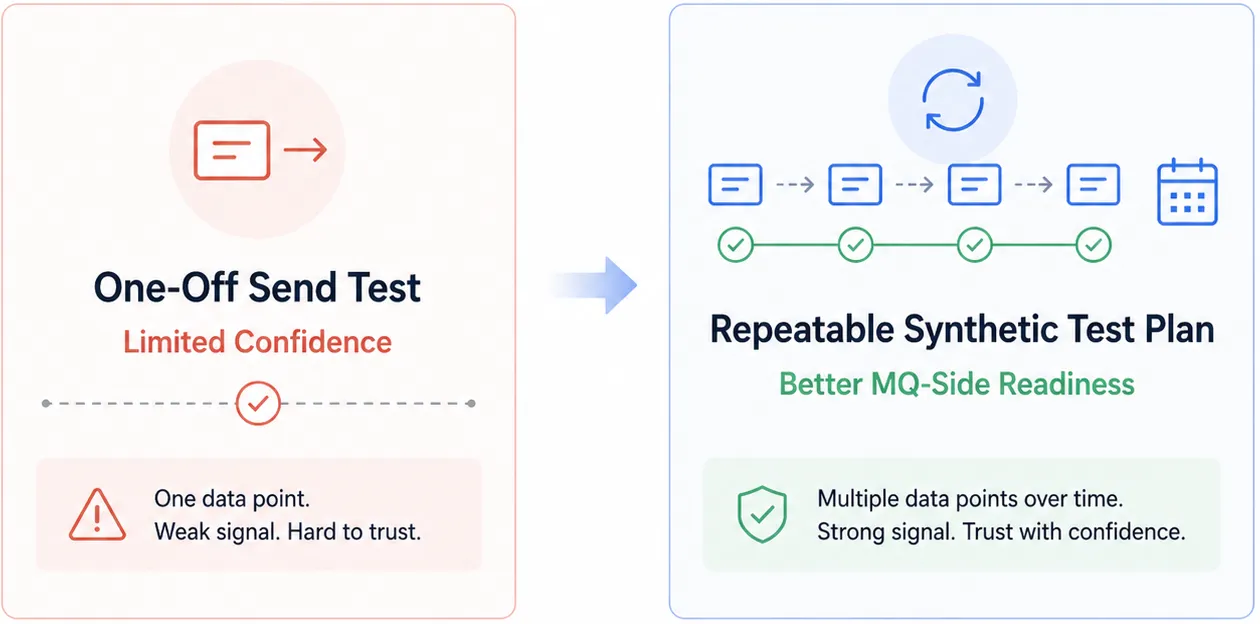
Sending one test message can confirm basic connectivity, but it does not tell the full story.
Before go-live, regression testing, or recurring readiness checks, teams need to know whether the MQ path can handle the details that matter in real environments: realistic payloads, headers, JMS properties, target routing, message counts, repeat patterns, audit history, notifications, and burst-volume behavior.
This checklist helps you move beyond one-time smoke tests and build reusable IBM MQ synthetic transaction test cases your team can repeat, review, and improve over time.
A Practical Worksheet for MQ-Side Test Planning
The IBM MQ Synthetic Transaction Testing Checklist helps your team plan repeatable message test cases focused on the MQ path itself.
Use it to document:
- Target queues, topics, or static targets
- MQI, JMS, or combined message types
- Payload resources
- Header data sets
- JMS properties
- Message counts, repeat patterns, and schedules
- Audit history and notification requirements
- MQ-side expected results and post-run findings
The goal is to help your team validate the MQ side of the workflow with tests that are reusable, realistic, and easier to review.
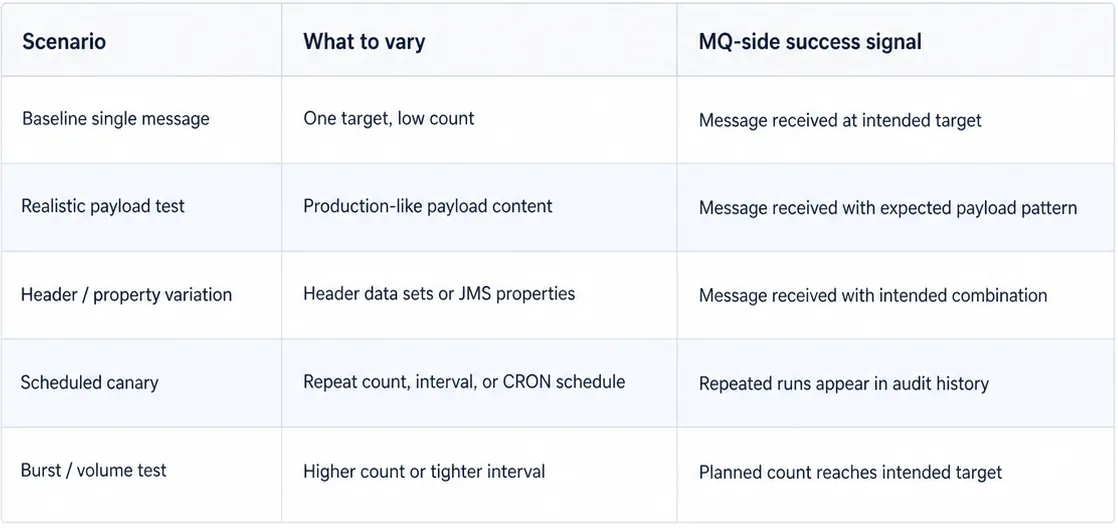
Inside the Template
The worksheet gives you a structured way to document the governance model around your MQ-to-RAG workflow.
You’ll be able to define:
- Pipeline scope, design guardrails, and review cadence
- Whether complete ingestion is required and how it should be validated
- Metadata that must be carried forward into downstream systems
- Sensitive data handling rules
- Role and team responsibilities
- View, alert, test, manage, or no-access permissions by object
- Alert ownership and escalation paths
- Synthetic testing ownership, cadence, and success criteria
- Exceptions to least-privilege access
- Review and sign-off checkpoints before go-live
Inside the Checklist
The worksheet gives you a structured way to plan, document, and reuse IBM MQ synthetic transaction tests.
Built for Teams That Need Repeatable MQ-Side Validation
This checklist is designed for teams responsible for planning, testing, validating, or supporting IBM MQ message flows before go-live, after changes, or as part of recurring readiness checks.
MQ-Side Readiness Needs More Than a Smoke Test
A basic send-and-receive test may be a useful starting point, but production workflows require more confidence.
A reusable MQ synthetic transaction test plan can help teams account for:
- Payload variation
- Header and JMS property behavior
- Routing to intended targets
- Message count expectations
- Burst, rate, or repeat behavior
- Queue-clearing decisions
- Audit history
- Execution notifications
Whether the test should be saved for - regression or scheduled canary use
The checklist also keeps the scope clear. It helps validate the MQ path itself. It does not claim to validate downstream consumer-app logic, embedding calls, vector-store updates, retrieval quality, grounded-answer quality, or full end-to-end tracing beyond confirming receipt at the intended MQ target
Five Steps to Plan a Reusable MQ Test Case
1. Define the test scenario
Name the test case, owner, purpose, target object, and message type.
2. Choose realistic message inputs
Document payload resources, header data sets, JMS properties, and any queue-clearing requirements.
3. Plan execution behavior
Set message count, expected total messages, repeat count, interval, CRON schedule, start time, end time, audit history, and notifications.
4. Confirm MQ-side validation points
Define what proves the message reached the intended target and whether headers, properties, message counts, burst behavior, audit history, and notifications worked as expected.
5. Record findings and decide reuse
Capture exceptions, follow-up actions, retest needs, and whether the test should be saved for regression, scheduled canary use, or retired.
The completed checklist gives your team a reusable record of what was tested, what happened, and what should change before the next run
Turn Test Planning Into Repeatable MQ Validation
The checklist helps your team plan what to test. Infrared360 helps teams operationalize repeatable IBM MQ synthetic transaction testing.
With Infrared360, teams can create MQ message test cases using defined targets, payload resources, header data sets, JMS properties, message counts, scheduling, notifications, and audit history. That makes it easier to run baseline checks, regression tests, scheduled canaries, and burst-volume scenarios without relying on one-off manual testing.
Use this checklist as a planning step before building repeatable synthetic transaction coverage in Infrared360.
Start With a Reusable MQ Testing Plan
Before go-live, regression testing, or scheduled readiness checks, use this checklist to plan IBM MQ synthetic transaction tests that account for message targets, payloads, headers, JMS properties, scheduling, audit, notifications, and burst-volume behavior.
Get immediate access to the reusable worksheet.