Best of 2025: Top Middleware Trends & Integration Guides
2025 was a turning point for enterprise IT.
Middleware stopped being just “plumbing.” It became the intelligence behind the operation. Looking back at the last 12 months, one thing is clear: the old ways of managing integration are gone.
What changed in 2025? According to the IBM 2025 Cost of a Data Breach Report, companies without proper AI governance and security controls paid nearly $670,000 more in breach costs than those that had them.
That financial pressure drove the three biggest shifts of the year: Intelligent Automation, Zero Trust Security, and a focus on Proactive Resolution.
We curated our top articles from 2025 to help you master these shifts.
At a Glance: The Trends That Defined 2025
If you want to modernize your stack for 2026, you need to master these four areas:
- Intelligent Automation: Replacing manual scripts with self-healing AI.
- Zero Trust Security: Verifying identity inside the messaging layer.
- Proactive Resolution: Setting metric baselines to reduce MTTR instead of just checking uptime.
- Hybrid Interoperability: Connecting protocols like MQTT and ActiveMQ seamlessly.
1. The Shift to Middleware Automation
Manual scripting is dead. That is the biggest takeaway from 2025. Modern environments move too fast for human-speed intervention. The industry has fully embraced “self-healing” architectures and smarter data structures.
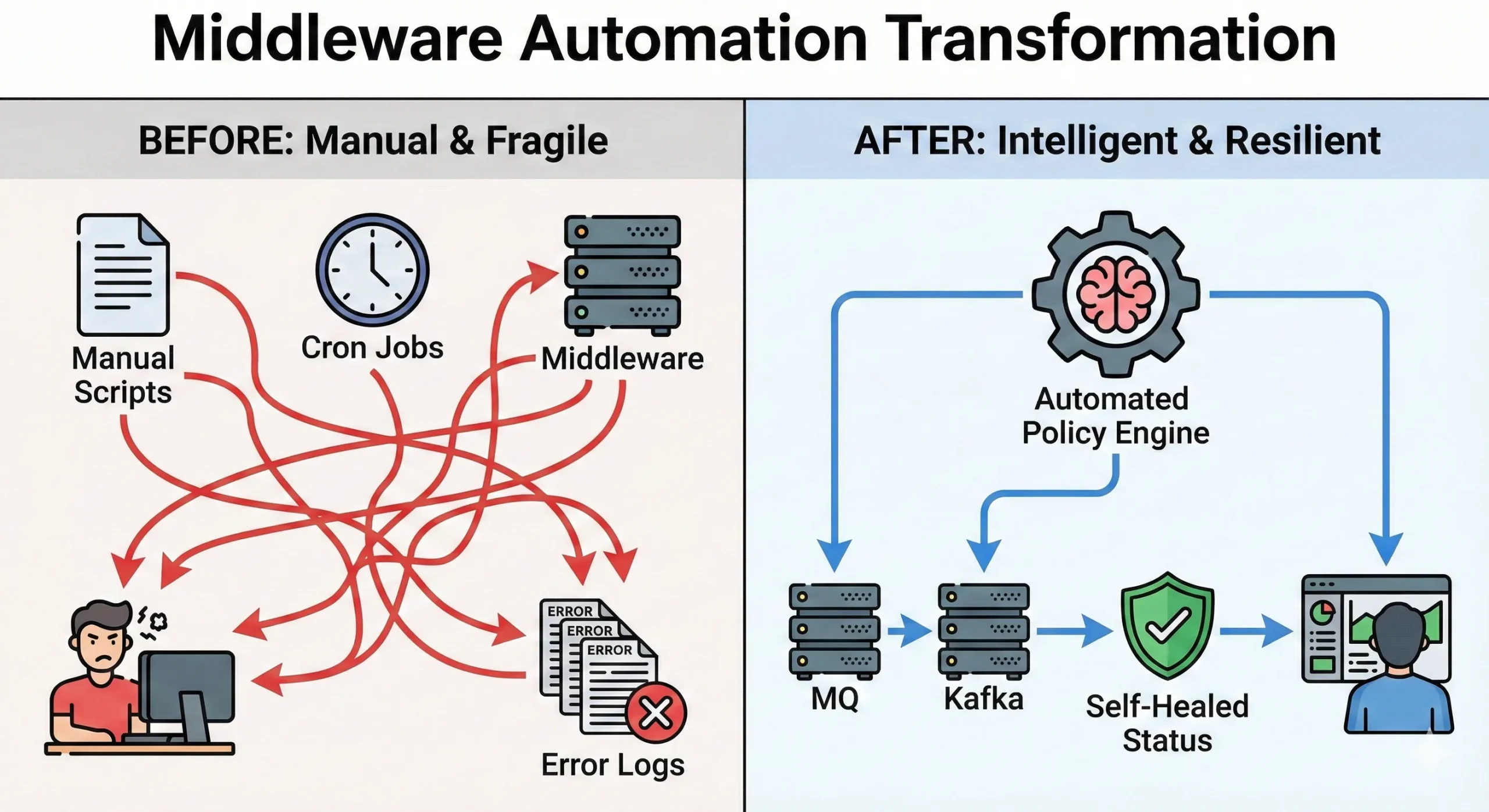
- Smarter Than Scripts: How Intelligent Automation Transforms IBM MQ Administration
Scripts are fragile and create silos. This article argues for policy-driven automation that can self-heal issues—like restarting channels or clearing queues—without the maintenance burden of custom code. (Nov 3, 2025) - Automated Self-Healing: The Middleware Architect’s Secret Weapon
Don’t just fix breaks; prevent them. This guide frames self-healing as a resilience strategy, showing you how to automate responses to common bottlenecks like queue overflows or certificate expirations. (Feb 4, 2025) - Advanced Tips for Automating Dead Letter Queue Management in IBM MQ
Manual DLQ processing is slow and risky. This post compares native IBM MQ tooling against policy-based handling, teaching you how to auto-correct recoverable failures and integrate alerts into your ITSM workflow. (Mar 5, 2025) - A Smarter Way to Handle Message Data: Understanding Context Trees in IBM App Connect Enterprise
Stop copying large payloads into the Environment tree. This deep dive introduces the Context Tree (expanded in ACE v13.0.5), a read-only structure that captures runtime state without memory overhead to improve debugging. (Dec 15, 2025)
2. Middleware Security & Zero Trust
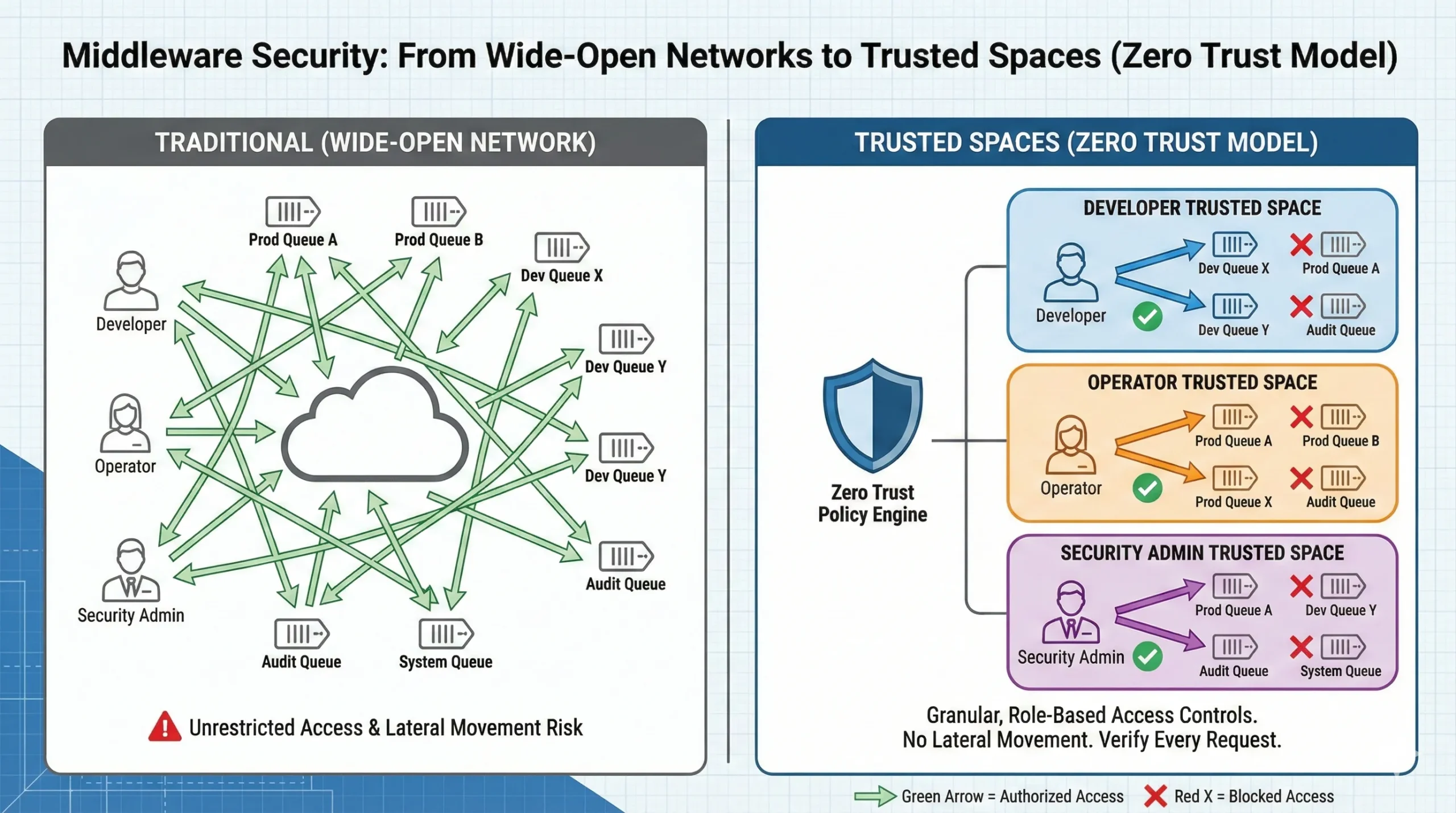
The “castle-and-moat” strategy failed. 2025 proved that threats often come from inside the network. The new standard is Zero Trust—verifying every user and service, every time.
- The Importance of Access Controls in MQ Incident Response
Security actually speeds up troubleshooting. This article explains how Role-Based Access Control (RBAC) allows App and Ops teams to triage queue build-ups immediately without waiting on an admin gatekeeper. (May 21, 2025) - MQ for Developers: Why Access Matters and How to Enable it Securely
Developers need visibility to debug, but full admin access is a risk. We present the concept of “Trusted Spaces,” giving developers read-only permissions to validate message flows without endangering production. (Apr 17, 2025) - Secure Remote Access to Transactional Middleware Environments
VPNs aren’t enough for FFIEC or GDPR compliance. This guide outlines a clientless security model that integrates SSO and 2FA to secure remote work without exposing sensitive endpoints. (Jan 21, 2025) - Securing IBM MQ in Kubernetes
Containers break traditional identity models because you cannot manage users inside every pod. This guide explains how to map external identities (LDAP/OIDC) and apply group-based RBAC for scalable Kubernetes security. (May 5, 2025)
3. Middleware Monitoring & Proactive Resolution
“Is the server up?” is the wrong question. In 2025, successful teams focused on Reducing Mean Time to Resolution (MTTR). Passive monitoring isn’t enough; you need actionable insights and accurate baselines to catch issues before they become outages.
- Are You Effectively Monitoring Your IBM MQ and Kafka Performance?
Siloed tools create blind spots that slow down resolution. This article argues for a “single pane of glass” that correlates events across MQ and Kafka to identify root causes faster. (Mar 25, 2025) - Establishing IBM MQ Metric Baselines: A Practical Guide
Stop guessing at thresholds. This guide offers a statistical approach to baselining, recommending you analyze 30 days of data to prevent false alarms and spot the subtle anomalies that precede a crash. (Feb 26, 2025) - IBM MQ Native HA: Enhance Message Resilience & Uptime
Native HA is distinct from clustering. This technical breakdown explains how Native HA uses an active leader with replicated logs for rapid failover, ensuring service continuity without manual intervention. (Apr 3, 2025)
4. Hybrid Cloud Integration
Integration is the new infrastructure. Enterprises rarely run on a single platform anymore. The ability to connect diverse protocols was a critical skill in 2025 and will be even more vital in 2026.
- Can an MQTT Client Work with Apache ActiveMQ Server? Yes, it can. ActiveMQ supports MQTT natively (v3.1.1 in Classic, v5.0 in Artemis). This guide walks through enabling the transport connector to bridge IoT data into enterprise systems. (Aug 7, 2025)
Conclusion: Get Ready for 2026
The trends of 2025—automation, security, and proactive resolution—are not fading away. They are becoming the baseline requirements for 2026.
If you aren’t using self-healing policies or Context Trees yet, now is the time to start.
Don’t Miss the Next Big Shift
The middleware landscape changes fast. Don’t get left behind with outdated tools or fragile scripts.
Join our Middleware Insights Newsletter. Get practical guides, security alerts, and integration tips delivered straight to your inbox every week.
Click here to subscribe